My method of tracking personal finances has helped us navigate uncertain and stressful life situations. Like two layoffs in a span of ten months, immigration and attorney fees (~$3,000-$15,000), unplanned international trips for family emergencies (~$10,000), or interstate moves that required making two house payments for over six months (~$12,000-$15,000). Many times, these overlapped with one another, for what we in America call, a double whammy. I am not stating that my method was the only reason we navigated these hard times; that would be foolish. It was also my spouse’s resilience, our frugality, general optimism toward life, and most times, good ol’ luck. But actively budgeting kept us in the “game” long enough and persevere these storms.
This method doesn’t use an app that consolidates finances (like Rocket Money), but relies on a spreadsheet and your commitment to maintaining it. It is a manual process which makes it so effective. It is not burdensome, however, and has the right amount of friction insofar that I have been using it for the past seven years. I tried other “convenient” ways to track our finances including mobile apps or commercially available computer software. I even programmed a custom solution in Python. Nothing beats the simplicity of my current approach, even with its minor inconveniences.
For many, their personal finances are unknown or scary or paralyzing, and they go to great lengths in avoiding them. However, what better way to confront your finances than to keep track of them? This is where my method shines. It lays all your finances in the open for you to rearrange, strategize or plan with. Using it consistently for months, even years, helps you develop an intuition about your finances that you could miss with a convenient finance consolidating app. Its like asking ChatGPT to do school work versus doing it yourself; the long term results are vastly different. This intuition mentors you into making good decisions, like your own personal financial coach. It also helps you be reactive to emergencies when necessary while balancing it out with other expenses.
The first step to get started with my method is to assign a designated financier for the family: a family member who will have access to all checking, savings, credit cards (even store-based cards like Macys), and investment accounts for all family members. In a family, it is best for spouses to do this together. Most spousal disputes start because the other did not know about an expense, this way that is avoided. In my household, I am the the designated financier while my spouse is the “we don’t need that (insert household item)” person.
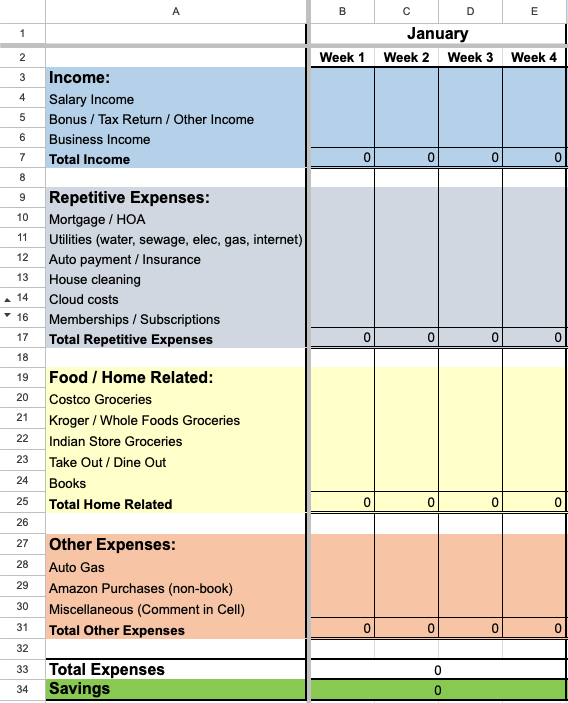
The second step is to create a spreadsheet like one shown at the end. The rows are major income and expense sections, and the columns are months divided into weeks. You can update the rows to your personal situation, but the weekly granularity of the columns is key in understanding trends and forming the aforementioned intuition. Separate tabs represent years that let you go back in time and be proud of the progress. This spreadsheet should be shareable to all family members. Mine is in Google Sheets that I share with my spouse. I like it better than Excel because it is browser based and can be shared easily without subpar contraptions like OneDrive.
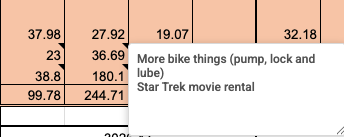
The third step, a recurring step you do every week (for me its Saturday), is to login into all family members’ accounts (checking, savings, credit cards, investment accounts) and input income/expenses in the spreadsheet. For miscellaneous and Amazon items (last couple rows of my spreadsheet), I add a note/comment for that expense. If you see a miscellaneous item recurring, is should be moved to the subscriptions section even if it isn’t one in a traditional sense. For example, recently we have been going to play pickleball by paying $14 per session. It is not a subscription but because we go every weekend, the regularity makes it one. If you travel often, that should be a row in your spreadsheet. We are not globe trotters and what sporadic traveling we do, it fits neatly in my miscellaneous section.
That’s it. Simple but effective.
It takes me about fifteen minutes every Saturday, and the habit is so well-formed that I do this while traveling, thanks to the internet and Google Sheets. On the last Saturday of the month, I also pay off our credit cards and am never late on any payments, resulting in a near perfect credit score. My spouse joins me once a month and we discuss our expenses. For example, we discuss how we can reduce eating out in the coming week after seeing high expenses in that category during previous weeks, or we discuss why I ordered another mechanical keyboard when I already have three (because this one is wireless and I want to reduce desk clutter). I question unrecognizable expenses greater than $100 on my spouse’s cards to limit fraudulent activity. In one of these sessions, I taught her the process and am confident she will be able to carry it forward for the household if Earth decided to get rid of me.
One could argue that a modern mobile app does this easily by providing login information for all financial institutions. True, but it is passive not to mention the cybersecurity concerns, and it doesn’t involve your family. An active involvement in your finances—the act of opening all accounts every week and inputting the numbers yourself with comments on miscellaneous items—is paramount in making them tangible and cultivating attentiveness to your household cashflow. For example, if the water bill is too high for a month, you will automatically cut down your shower time by a few minutes (that intuition again!), and these behavior changes only come from active involvement. An app may inform you about this and also have fancy features to cancel or reduce expenses, but it will not cut off your water mid-shower beyond a threshold; that’s on you.
Doing this together with family members, including kids, has the added advantage of having them all on the same page where new insights and habits can be easily transferred. Schools do not cover basic financial literacy, and having open conversations about household finances with your kids has its advantages. Growing up, I knew my parents incomes and salaries precisely because my father kept an open journal to record cash flow, and I studied it often. It made me cognizant about when to ask my parents to buy me something and to not be wasteful (rice costs this much!; I better finish what’s on my plate). These implicit lessons have trickled into my adult life and my process is a reflection of that.
In the end, it is your money and you should control it, so that it doesn’t control you. My method espouses just that. Improved savings, budgeting, reasonable frugality, and financial resilience are just side effects.